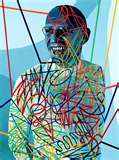
It is the terrorist model to bring about an excess of reality, and have the system collapse beneath that excess. - Baudrillard
Following Nietzsche's advice, we might sound out concepts with a hammer. This might perhaps be a good way of conducting our interviews. Nietzsche, whose searing words accompanied you through adolescence. (Baudrillard - Fragments p 1)

It was a relationship that went in fits and starts, so to speak, and there was an enormous period of eclipse in it. I was a great devotee of Nietzsche. I read him very early, in the sixth form. I was even lucky enough to have him in both the written and oral German agregation exams, though that was my undoing, as the examiners didn't agree at all with my reading; Nietzsche took his revenge there, unless we take the view that he did me a favor by preventing me from passing the exam. After that I stopped reading him entirely. I held him in a kind of quasi visceral memory, but I'd only retained what I wanted to. I would remember particular aspects of his thought, or find aspects of it emerging in a more or less aphoristic memory. There was a long eclipse, but I was already on the ecliptic. All in all, Nietzsche was never, strictly speaking, a reference for me, but an ingrained memory.
Nietzsche is in me in the mode of the unzeitgemass as he puts it himself, the mode of the untimely.
In talking with you about Nietzsche, I was thinking tn particular of the genealogical method which enables us to uncover what lies hidden behind ideas, to see their real basis. (Francois L'Yvonnet in Fragments - Baudrillard p.2)
That was the method I followed, but my material came from worldly affairs. There are no other ways of thinking, it seems to me. In this sense, Nietzsche really is a unique thinker. I don't see any other like him.
 Perhaps one only ever studies one philosopher seriously, just as one has only one godfather, as one has only a single idea in one's life. Nietzsche is, then, the author beneath whose broad shadow I moved, though involuntarily, and without even really knowing I was doing so. I've quoted him at times, but not often. And I've never even thought of mobilizing or adapting him for my own ends. If I come back to him now, this is doubtless because I'm going back to the aphoristic form, in writing and photography. Though Nietzschean aphorisms are often of such scope that they're perhaps something other than aphorisms. At any rate you can use Nietzsche aphoristically, and not philosophically or ideologically. (Baudrillard - Fragments p. 2)
Fragments is one of his last books. He died in 2007 and his thought was still changing up until his death.
 Ayn Rand read Nietzsche also at an early, impressionable age. It is my belief that she was thoroughly steeped in Nietzchean thought so much so that Nietzsche permeates all the fiction she ever wrote. And like Baudrillard, I believe Nietzsche was IN HER. Nietzsche, like Lovecraft, enters your mind and influences it, if not for all time, for a very long time, and is terribly difficult to shake off. That is, if you even want to. As is known about Rand, she was incredibly capable of extreme denial. Baudrillard, of course, is too sophisticated a scholar to not know this about himself and he identifies it. Rand was totally occupied with writing fiction that cut into the Dominating Discourse of America and changed the way we think in many areas. I also believe that her great influence has to do with Nietzsche seeping through the interstices of her mind into ours.
__________________________________________________________________________________
Number 1 in Notes: Journal of Ayn Rand Studies , Vol 10 number 2 p 340

It was a relationship that went in fits and starts, so to speak, and there was an enormous period of eclipse in it. I was a great devotee of Nietzsche. I read him very early, in the sixth form. I was even lucky enough to have him in both the written and oral German agregation exams, though that was my undoing, as the examiners didn't agree at all with my reading; Nietzsche took his revenge there, unless we take the view that he did me a favor by preventing me from passing the exam. After that I stopped reading him entirely. I held him in a kind of quasi visceral memory, but I'd only retained what I wanted to. I would remember particular aspects of his thought, or find aspects of it emerging in a more or less aphoristic memory. There was a long eclipse, but I was already on the ecliptic. All in all, Nietzsche was never, strictly speaking, a reference for me, but an ingrained memory.
Nietzsche is in me in the mode of the unzeitgemass as he puts it himself, the mode of the untimely.
In talking with you about Nietzsche, I was thinking tn particular of the genealogical method which enables us to uncover what lies hidden behind ideas, to see their real basis. (Francois L'Yvonnet in Fragments - Baudrillard p.2)
That was the method I followed, but my material came from worldly affairs. There are no other ways of thinking, it seems to me. In this sense, Nietzsche really is a unique thinker. I don't see any other like him.
 Perhaps one only ever studies one philosopher seriously, just as one has only one godfather, as one has only a single idea in one's life. Nietzsche is, then, the author beneath whose broad shadow I moved, though involuntarily, and without even really knowing I was doing so. I've quoted him at times, but not often. And I've never even thought of mobilizing or adapting him for my own ends. If I come back to him now, this is doubtless because I'm going back to the aphoristic form, in writing and photography. Though Nietzschean aphorisms are often of such scope that they're perhaps something other than aphorisms. At any rate you can use Nietzsche aphoristically, and not philosophically or ideologically. (Baudrillard - Fragments p. 2)
Fragments is one of his last books. He died in 2007 and his thought was still changing up until his death.
Ayn Rand read Nietzsche also at an early, impressionable age. It is my belief that she was thoroughly steeped in Nietzchean thought so much so that Nietzsche permeates all the fiction she ever wrote. And like Baudrillard, I believe Nietzsche was IN HER. Nietzsche, like Lovecraft, enters your mind and influences it, if not for all time, for a very long time, and is terribly difficult to shake off. That is, if you even want to. As is known about Rand, she was incredibly capable of extreme denial. Baudrillard, of course, is too sophisticated a scholar to not know this about himself and he identifies it. Rand was totally occupied with writing fiction that cut into the Dominating Discourse of America and changed the way we think in many areas. I also believe that her great influence has to do with Nietzsche seeping through the interstices of her mind into ours. __________________________________________________________________________________
Number 1 in Notes: Journal of Ayn Rand Studies , Vol 10 number 2 p 340
1. One indication of the degree of Nietzsche’s influence on Rand can be
gleaned from the fact that, as Rand related to Barbara Branden (1986, 45), “The first
book I bought myself in America was an English version of Thus Spake Zarathustra,
and I underscored all my favorite sections.” Not only did Rand have many favorite
sections in this work, but she underscored them all in an English-language edition
even though “her English was halting and uncertain” at that time (68). She must
have known the work extremely well.
This is my point.